To : All Daniel's Fans , Run this test and you shall see how well do you know about Daniel ^^
More IQ Tests and other quizzes! |

To : All Daniel's Fans , Run this test and you shall see how well do you know about Daniel ^^
More IQ Tests and other quizzes! |


 According to his management (which means it might not be true, or even happen), South Korean pop star and actor Rain (his stage name, his real name is Jung Ji-Hoon) will be joining the cast of the Wachowski Brothers’ live-action adaptation of “Speed Racer” (the brothers’ first G-rated movie, no less). Dark Horizons says that negotiations for Rain (who was recently in Park Chan-wook’s “I’m a Cyborg, but That’s Okay”) to join the cast, which already includes star Emilie Hirsch and Christina Ricci, isn’t yet complete, and there’s no word on what role he’ll play.
 Speed Racer’s nemesis will be played by Matthew Fox, so that’s not it. Most likely Rain’s Hollywood debut will be a secondary role, possibly as a fellow racer?
More about Rain from Wikipedia:
Rain (Real name: Jung Ji-Hoon) is a male Korean R&B and pop singer.
He has become well-known throughout East Asia — including Japan, Hong Kong, Korea, Taiwan, Mainland China, Philippines, Malaysia, Singapore and Thailand — as a leading star of the Korean wave, otherwise known as Hallyu.
In April 2006, Time named him as one of the “100 Most Influential People Who Shape Our World.” In 2007, Rain was voted by Time Magazine’s online user poll as the most influential person in 2007, although he was not in the magazine’s actual list. He also made it into People’s 2007 list of the “Most Beautiful People” in the world.
ah !!! Rain !!! You are so cool !! LOVE YOU !!!!!
SPEED RACER
SPEED RACER WARNERBROS WEB LINK :
 , since i was form 2 , that's 14 years old ba ~ and when the first time i listen to it , i was totally oh my god , this is my song man ~ i really love it !! So , recently , i found it again in one of my USB driver ( i thought i lost it ) , again , i found this song back ~ reminds me lots and lots of memories and stuff ( I m actually excited to hear it ) , and how i in love with it ~ the guitars and clappings ~ feels really cool ~ abit classical and A-capella, add on with some Broadway , making it as blue as it can be , and the meaning ~ woah ~ its , sad ~
 indeed. But what i mostly amazed about was that , david , uses his voice , and turn that song into another whole feelings ~ and it was really surprising to know that , he actually create and composes that whole song himself , what a talented singer he was. He plays the guitar , sing the song , although with his voice can be categorized as normal vocalist , but the point is , he sings out with feelings , that's what makes it even more wonderful , i love all of his album ( don't believe me ? try searching for more you 'll see ) , melts people with his voices and musics ~ how great , he certainly knows how Broadway and jazzy and blues should run , such creative singer. And , not only blues he create but also songs with modern creation R@B tunes , how Impressive. I can say , this song , is the most creative song i ever heard in my entire life ~ that's why , i like it for years man ~ for years , is always running in my mind ~ just listen to the intro , you will certainly faint for the guitar's wonderful movement ( I m , but don't know you
  ) then , it makes me wanna to sing together along ~ muahaha ~ even some well known singer loves his songs as well !!
 ( I save it for my latest theme as well )
David Tao was born in 11 July 1969 in Hong Kong (Hometown: Shanghai), as Tao Xu Zhong (traditional Chinese: 陶緒忠; simplified Chinese: 陶绪忠; pinyin: Táo Xùzhōng), to parents who were considered famous entertainers in Taiwan. His father, Tao Da Wei (traditional Chinese: 陶大偉; simplified Chinese: 陶大伟; pinyin: Táo Dàwěi) (the latter two characters which can also be read as "David", hence essentially David Tao Senior), was an actor/singer/composer and his mother, Wang Fu Rong (traditional Chinese: 王復蓉; simplified Chinese: 王复蓉; pinyin: Wáng Fùróng), a very well known Chinese opera singer.
David spent part of his childhood in Hong Kong (something which he shared with his audience during his Soul Power concerts in Hong Kong). His parents supposedly eloped when his father could not get approval to marry his mother. David had his education in Taiwan from kindergarten to the junior high school level at the Bethany Campus of Morrison Academy in Taipei. Later, his father decided to pursue his dream of working for Walt Disney, and they migrated to the United States where David Tao Sr. realised his dream and worked as an animator in Disney Burbank.
His parents later returned to Taiwan where his father began his singing career, leaving David to complete his education in the United States. Left to fend for himself, David took on many jobs, including a stint as a policeman in the LAPD, without the knowledge of his parents. Eventually, he graduated with a bachelor degree in Psychology from UCLA.
Later working as a salesman, he was offered a job by reputed Taiwanese producer Wang Zhi Ping, when the latter found out who he was. So David went back to Taiwan, initially writing, and later producing songs for many singers before releasing his self-titled album David Tao in 1997. He has since released four more albums, a live concert recording and a compilation of his best songs. His works have influenced many singers to acknowledge his works more than the normal listener. Singers that actually listen to David Tao include Eason Chan, Jay Chou, Wang Lee-Hom, JJ Lin, Tank, Bibi Zhou, etc.
His personalities are best described as "creative, subjective and nervous". He is a typical perfectionist. His hobbies are watching movies & dramas, visiting museums and reading psychology books.
David Tao is also an avid car enthusiast. When he is not working in Taiwan, he enjoys driving his 1970 Ford Mustang in LA.
David Tao is a firm believer of Christianity. He has written songs that have underlying Christian themes and references to them such as, Butterfly, Dear God, Rain and Sweet Hour of Prayer. He also widely preaches in the concept of love, which is central to the Christian belief.
It would seem that his songs contains names of women, the reasons which is unknown. Among the more popular songs using the names of women are Catherine, Katrina, Angeline, Angel, Olia, MelodySusan Said. and
The Taiwanese media later uncovered the intention of the song 'Melody' which is named after one of David Tao's ex-girlfriend (Pinyin: Yin Yue; Melody Yin) from LA. She also returned to Taiwan for a music career. Her song called "Love is Not Here" (愛不在) composed by David Tao is one of her most famous songs. She also had an opportunity to duet with Van (范逸臣) in the song called Ya De Li Ya Hai (亞德里亞海).

Discography
In 1997, with the help of Wang and another Taiwanese producer, Jim Lee, Tao released his self-titled first album (David Tao), under an independent label called Shock Records, set up by Taiwanese pop singer Jin Ruei-yao, and her husband. This album set a record in Taiwan during the 9th Golden Music Awards, as the first album from a new singer ever, to be nominated for a total of 5 awards - Best Newcomer, Best Singer, Best Producer, Best Song and Best Album.
Airport 10.30 first caught people's attention, but it was the simply arranged, melodic I Love Youa cappella song, Spring Wind, which was a new R&B version of a favorite old Taiwanese song. David sang all the vocals in this song, which still stands today, widely regarded as one of the best a cappella songs in Chinese. that became one of Tao's signature tunes. The album also featured an
Airport 10.30 was also nominated for the MTV Awards for Best Chinese Video in 1998 along with Coco Lee, who became the eventual winner.
Tao won two of the awards, namely Best Newcomer and Best Producer, becoming the first newcomer/singer to also win a Best Producer award. Tao's first album was notable for the excellent production which, remarkably, was done in Tao's home in Los Angeles entirely. The album also broke new ground in the music style and arrangement with its strong Western-influenced R&B flavor.
Tao shot to an unprecedented meteoric rise to fame following the release of David Tao. Unable to cope with the sudden media attention, he flew back to Los Angeles soon afterwards.
Between David Tao and his next album, besides releasing a remixed Bastard Pop ep, writing and producing songs for various hit Taiwanese singers, notably a theme song which became one of Taiwanese boyband Tension's hit songs, I'll Be With You, David was not heard on the Mandarin-Pop scene for a long while as he quietly disappeared into obscurity.
In 1999, two years after his first album, Tao released his second album I'm OK. This album was claimed to be a best-selling album by breaking the previous record by selling 600,000 copies, yet various critics had claimed that the impact of I'm OK was not any stronger than his previous work in terms of style and arrangement.
Notable hits include:
In this album, Tao attempted many musical styles, including, unsurprisingly, his favorite rock music. In fact, some critics have noted that each of his songs are different from one another, in terms of their style and music arrangement.
David was nominated for six GMA awards for I'm OK - Best Album, Best Producer, Best Singer, Best Video, Best Song and Best Song Arrangement. He only won the Best Producer Award on the GMA, but Rain later went on to win Best Chinese Video at the 2000 MTV Music Awards.
In 2002, Tao released Black Tangerine. Some notable songs in this post-911 album, of which he derived much of his inspiration from:
What set Black Tangerine apart was the strong social commentary, including a track consisting of various actual Taiwanese news snippets of unrelated family tragedies and public incidents, placing the state of Taiwanese society in a somewhat negative point of view.
Black Tangerine won various awards in Asia but was, incidentally, overlooked for the Golden Music Awards in Taiwan, where the album was originally intended for.
David has since held a series of successful concerts in Hong Kong, Taiwan, Malaysia and Singapore in 2003, having already won many fans over with his signature simplistic style.
In 2005, David Tao released his fourth album, The Great Leap 2005. The Great Leap 2005 is David's most successful album so far. The Great Leap had 4 nominations at "17th Golden Melody Awards" however he was only able to grab the "Best Album Award". Notable songs in the album include:
A fifth studio album by David was released on 4th August 2006. "Beautiful" was a successful album which had 3 nominations in GMA, being nominated with Best Song, Best Composer and Best Male Vocalist. Despite of David being a GMA veteran he never won Best vocalist and this time this was also no exception with David only winning Best Song with his Marry Me Today. Among the more popular songs in the album are the title song Too beautiful, another old song restyled into David's signature arrangement, Can't Get You Outta My Mind, and a duet song with Jolin Tsai, Marry Me Today. It has been rumored that during the filming of the MTV with Jolin on the song Marry Me Today, he refused to hold hands with her, perhaps out of sheer shyness.

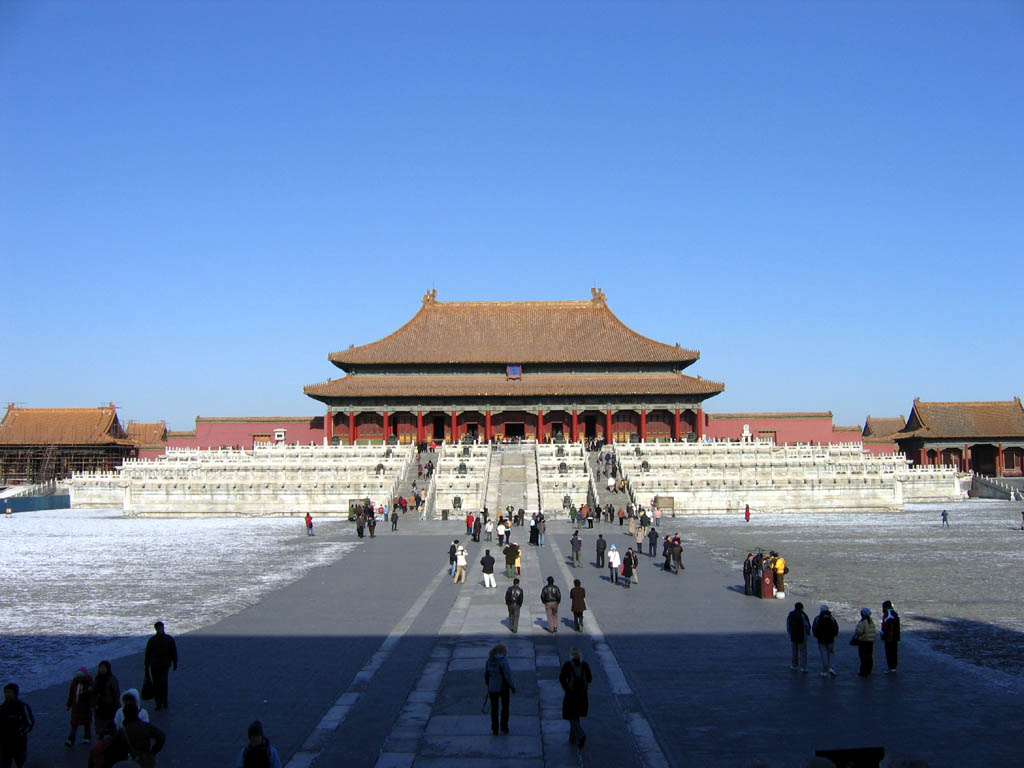
The Forbidden City was the Chinese imperial palace from the mid-Ming Dynasty to the end of the Qing Dynasty. It is located in the middle of Beijing, China and now houses the Palace Museum. For almost five centuries, it served as the home of the Emperor and his household, and the ceremonial and political centre of Chinese government.
Built from 1406 to 1420, the complex consists of 980 surviving buildings with 8,707 bays of rooms[1][2] and has influenced cultural and architectural developments in East Asia and elsewhere. The Forbidden City was declared a World Heritage Site in 1987,[2] and is listed by UNESCO as the largest collection of preserved ancient wooden structures in the world. and covers 720,000 square metres. The palace complex exemplifies traditional Chinese palatial architecture,
Since 1924, the Forbidden City has been under the charge of the Palace Museum, whose extensive collection of artwork and artefacts were built upon the imperial collections of the Ming and Qing dynasties. Part of the museum's former collection is now located in the National Palace Museum in Taipei. Both museums descend from the same institution, but were split after the Chinese Civil WarThe common English name, "the Forbidden City," is a translation of the Chinese name Zijin Cheng (Chinese: 紫禁城; pinyin: Zǐjinchéng; literally "Purple Forbidden City"). Another English name of similar origin is "Forbidden Palace". In the Manchu language it is called Dabkūri dorgi hoton (Manchu: 
The name "Zijin Cheng" is a name imbued with significance on many levels. Zi, or "Purple", refers to the North Star, which in ancient China was called the Ziwei Star, and in traditional Chinese astrologyCelestial Emperor. The surrounding celestial region, the Ziwei EnclosureChinese: 紫微垣; pinyin: Zǐwēiyuán), was the realm of the Celestial Emperor and his family. The Forbidden City, as the residence of the terrestrial emperor, was its earthly counterpart. Jin, or "Forbidden", referred to the fact that no-one could enter or leave the palace without the emperor's permission. Cheng means a walled city. was the abode of the (
Today, the site is most commonly known in Chinese as Gugong (故宫), which means the "Former Palace." The museum which is based in these buildings is known as the "Palace Museum" (Chinese: 故宫博物院; pinyin: Gùgōng Bówùyùan)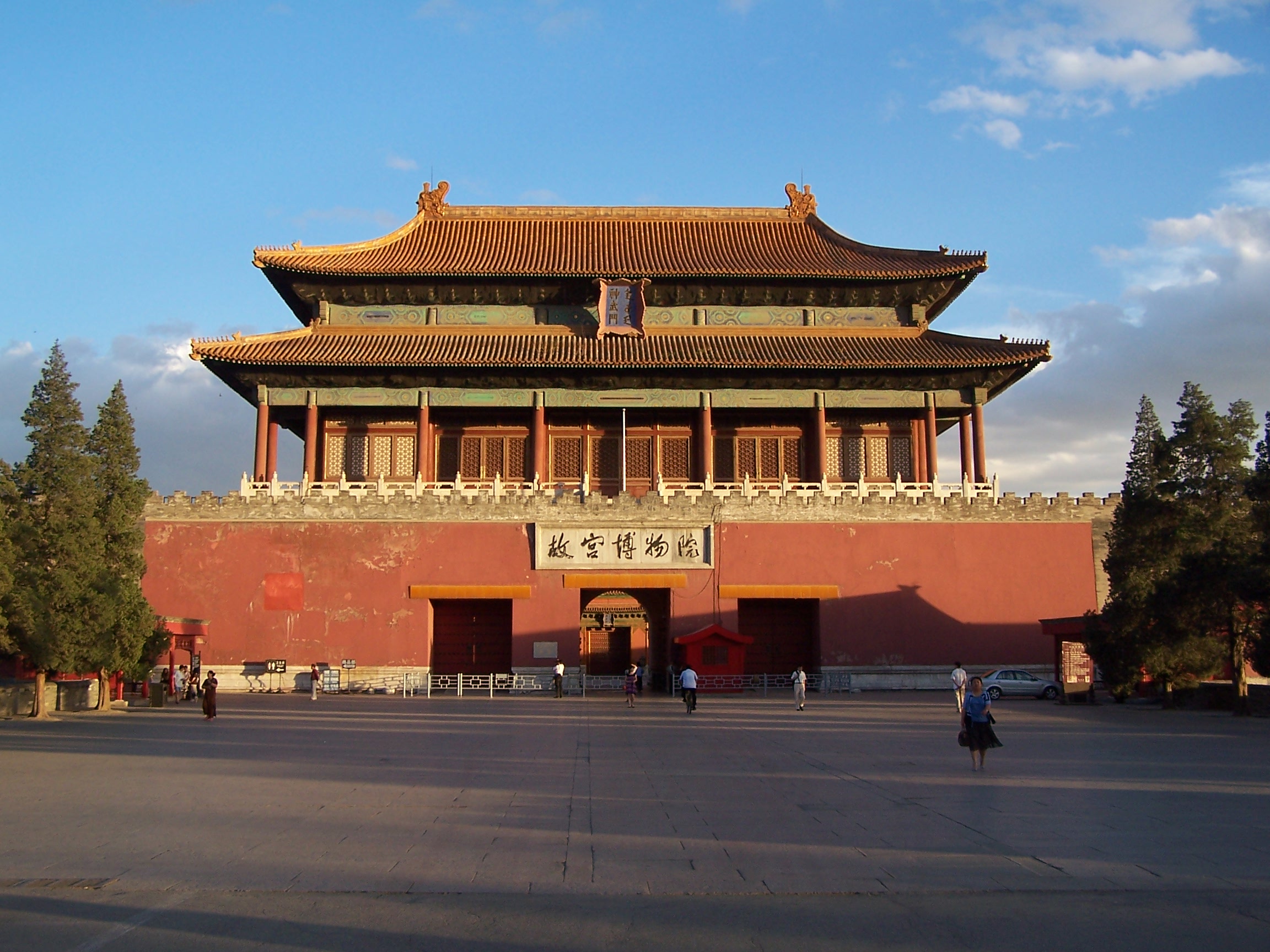

Religion was an important part of life for the imperial court. In the Qing Dynasty, the Palace of Earthly Harmony became a place of Manchu Shamanist ceremony. At the same time, the native Chinese Taoist religion continued to have an important role throughout the Ming and Qing dynasties. There were two Taoist shrines, one in the imperial garden and another in the central area of the Inner Court.
A prevalent form of religion in the Qing Dynasty palace was Tibetan Buddhism, or Lamaism. A number of temples and shrines were scattered throughout the Inner Court. Buddhist iconography also proliferated in the interior decorations of many buildings. Of these, the Pavilion of the Rain of Flowers is one of the most important. It housed a large number of Buddhist statues, icons, and mandalas, placed in ritualistic arrangements.